How does rugby work?
How does rugby work? Tries, conversions, tackles, and more: We’ll explain rugby union, rugby league, and what makes rugby so exciting for sports betting.
approx. 5 min.
How does rugby work?

At first glance, rugby seems like uncontrolled chaos: an oval ball, hard tackles, and dense clusters of players that are almost impossible to tell apart. Behind that powerful first impression, however, lies a surprisingly structured game with clear sequences, its own terminology, and its own logic. So how does rugby really work, and what should you look out for if you want to understand the game or bet on it?
Rugby at a Glance: Two Variations, One Basic Principle
Before we take a closer look at rugby and the rules of the game, let’s briefly review the basic structure. After all, not all rugby is the same. Internationally, there are two major variants that have evolved from the same roots: Rugby Union, with 15 players per team, and Rugby League, with 13. Both use an oval ball, both are played on a rectangular grass field, and in both, the goal is to carry the ball into the opponent’s try zone. However, the pace, ball possession, and tactics differ in each variant.
Rugby Union dominates most international competitions. Rugby League is particularly strong in northern England and Australia and is considered faster and more compact. We will therefore focus primarily on Rugby Union and highlight the key differences from Rugby League where appropriate.
How Does Rugby Work? A Quick Overview of the Most Important Rules
- Each team has 15 players on the field (Rugby Union) or 13 (Rugby League).
- A game lasts 80 minutes, divided into two 40-minute halves.
- The ball may be carried, passed backward or to the side, and kicked in any direction.
- A forward pass with the hand is prohibited and is penalized with a scrum.
- Points are awarded for a try in the opponent’s in-goal area, as well as for a conversion, penalty kick, or drop goal.
- Only the player carrying the ball may be tackled—that is, gripped and stopped—and high tackles above the shoulders are prohibited.
- The ball remains in play as long as a team retains possession in accordance with the rules (Union) or until the sixth tackle (League).
Scoring Points: How Points Are Counted in Rugby
In rugby, there are four ways to score points—each with its own point value and specific game situation. If you want to understand the rules of rugby, you can’t avoid these four terms:
- Try – 5 points: The classic. A player places the ball in the opponent’s in-goal area in a controlled manner. This is the main way to score points and the play that appears in every highlight reel.
- Conversion – 2 points: Immediately after a successful try, the team gets to kick. The ball must be kicked from the ground between the H-shaped goalposts and over the crossbar. It sounds simple, but it depends heavily on the angle to the posts.
- Penalty Kick – 3 points: If the opponent commits a foul, the attacking team can kick directly at the goalposts instead of continuing play. A safe way to play it safe in a close game.
- Drop goal – 3 points: A kick taken during open play. The ball is briefly dropped to the ground and kicked over the crossbar as it bounces. Spectacular and often decisive in tight closing stages.
Important: In Rugby League, the scoring system is slightly different: A try is worth only 4 points, the conversion remains at 2, and the drop goal is worth only 1. So the scores feel quite different in both variants.
Sounds exciting? Then click over to MERKUR BETS and see what odds are currently available for rugby sports betting.
Why a try in rugby is more than just a score

How does rugby work, from the kickoff to the final whistle? Here's how a game unfolds
A rugby match lasts 80 minutes and consists of two 40-minute halves. The game begins with a kickoff from the center line, and the ball remains in play until it rolls out of bounds, a foul is committed, or a point is scored.
Rugby gets particularly exciting during set pieces that follow stoppages in play. There are three you should know about:
- Scrum: Eight forwards from each team form a tight block; the ball is thrown in at the center and kicked backward with the feet. It looks rough, but it’s strictly regulated.
- Lineout: When the ball goes out of bounds on the sideline, both teams line up parallel to each other; one player throws the ball between the rows, and a teammate is lifted into the air to catch it. This is one of the most iconic scenes in rugby.
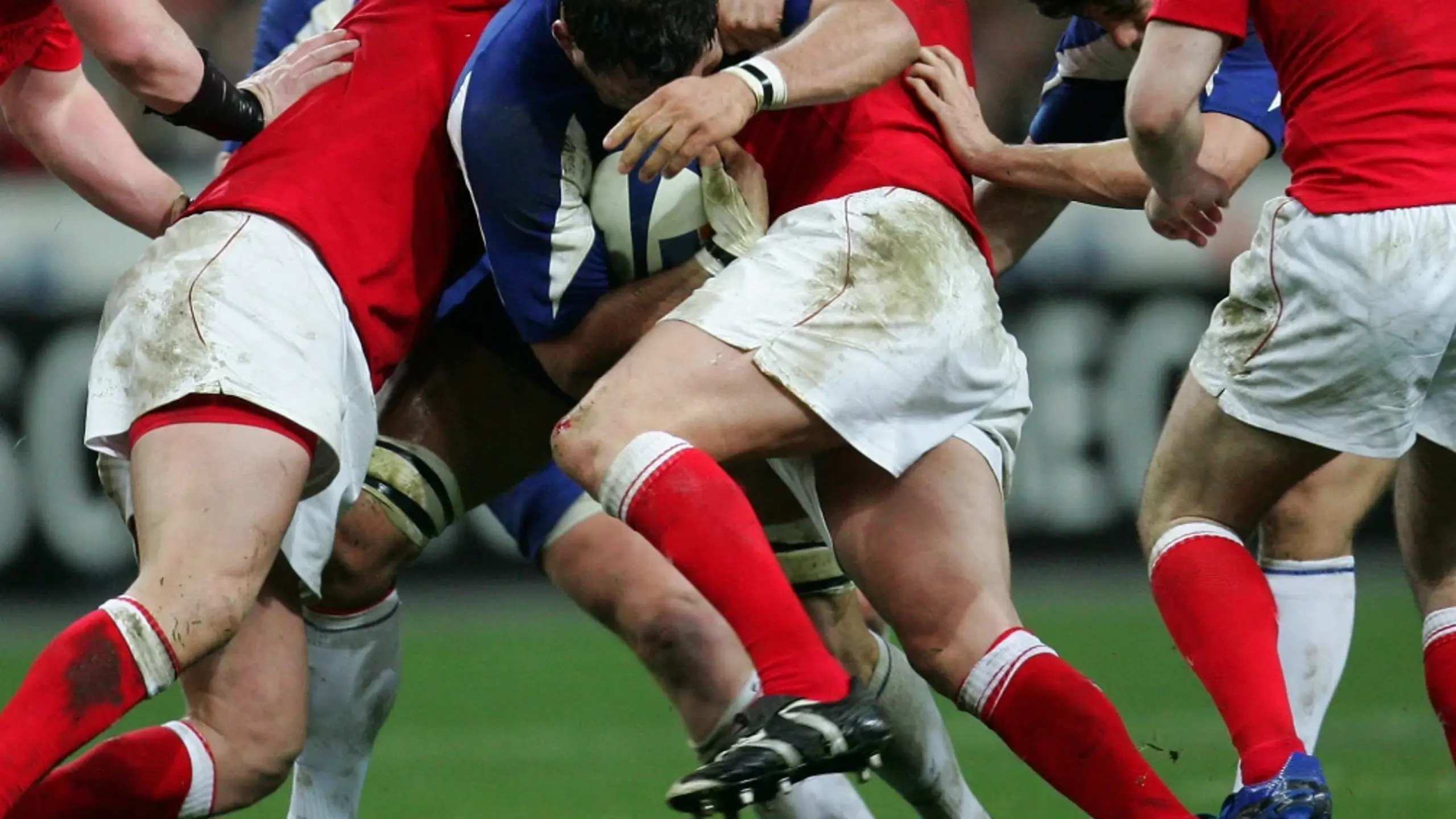
- Ruck and Maul: After a tackle, a tangle of players often forms around the ball on the ground (ruck) or while standing (scrum). This is exactly where it’s decided which team gets to continue the attack.
An important difference from Rugby League: In Rugby League, possession isn’t contested after a tackle. Instead, the tackled player kicks the ball back, and possession changes after six tackles at the latest. This makes Rugby League faster and more clearly structured, while Rugby Union allows for longer phases of attack.
Fouls and Penalties in Rugby: When Speed Turns into Discipline
As physical as rugby may seem, the rules of the game are clearly designed to protect the players. Tackles are only allowed below the shoulders; a high tackle results in an immediate penalty kick. In addition, there are other typical foul scenarios:
- Forward Pass: The ball may only be passed backward or sideways with the hand. Consequence: A scrum for the opposing team.
- Knock-on: If a player loses the ball forward by dropping it, a scrum is also awarded to the opposing team.
- Offside: Any player positioned ahead of the teammate carrying the ball is offside and may not participate in the play.
- Dangerous play: High tackles, dangerous tackling, or intentional obstruction are penalized with a penalty kick, a yellow card, or a red card.
When a player receives a yellow card, he must spend 10 minutes in the “sin bin,” rugby’s version of the penalty box. During this time, his team plays with one fewer player—in tight games, this can completely turn the tide of the match.
Rugby Betting: What's Interesting for Sports Betting Fans
It’s this combination of power, precision, and set plays that makes rugby so appealing for sports betting: a penalty here, a try there, and in between, a drop goal from 30 meters. The score is constantly changing—and so are the odds.
When it comes to your tip, it's worth keeping a few factors in mind:
- Home-field advantage: In rugby, the home crowd traditionally plays a major role, especially in stadiums like Twickenham, Aviva, or Eden Park.
- Kickers’ skill: Teams that reliably convert conversions and penalty kicks score the decisive points in close games.
- Weather conditions: Rain and wind significantly affect kicks and ball handling—in wet games, there are often fewer tries and more penalty points.
- Discipline: Teams that commit many penalties or receive many cards regularly give their opponents three points or open up the field.
At MERKUR BETS, you'll find a wide selection of rugby events, from the Six Nations to the World Cup—with attractive odds and exciting odds boost promotions time and time again.
Position Play and Tactics: Why Rugby Is More Than Just Power

An Overview of the 4 Major Rugby Events
If you want to bet on rugby, you should be familiar with the year’s most important tournaments. Here are the most exciting games that define the sport:
- 2027 Rugby World Cup: The World Cup will take place in Australia from October 1 to November 13, 2027—featuring 24 nations for the first time and a new round of 16. The final will be held at Stadium Australia in Sydney. For many, the World Cup is the highlight of the rugby calendar.
- Six Nations: The most prestigious annual tournament in the Northern Hemisphere. England, France, Ireland, Italy, Scotland, and Wales play a round-robin format in February and March. The team that wins all five matches claims the Grand Slam.
- The Rugby Championship: The Southern Hemisphere counterpart to the Six Nations. Here, Australia, New Zealand, South Africa, and Argentina face off—often at the highest level of play of the year.
- British & Irish Lions Tour: A special event that takes place only once every four years. The best players from England, Scotland, Wales, and Ireland form a single team and tour to face top nations in the Southern Hemisphere.
Your Rugby Bet at MERKUR BETS
Do you know the rules of rugby union, rugby league, and the most important aspects of the game? Then all that’s missing is your bet. Discover bets on the biggest tournaments and top individual matches at MERKUR BETS , from the Six Nations to the 2027 Rugby World Cup. Click through, choose a match, check the odds, and join in the action.
FAQ on How Rugby Works
Both versions share the same origins but have diverged over time. Rugby Union is played with 15 players per team, while Rugby League is played with 13. In Union, a team can theoretically retain possession of the ball indefinitely; in League, a team has only six tackles to score or kick—after that, possession changes hands. The scoring and set plays also differ. Rugby Union is considered more tactically complex, while Rugby League is seen as faster and more compact.
A professional rugby game lasts a total of 80 minutes and is divided into two halves of 40 minutes each. With brief interruptions for injuries, referee decisions, and set pieces, a full match—including halftime—typically takes a good two hours.
This rule is one of the defining characteristics of rugby. The ball may only be passed backward or to the side with the hand; it may only move forward if a player carries or kicks it himself. This gives rise to the typical pattern of diagonal passing. If the ball falls forward, it is considered a knock-on and is penalized with a scrum for the opposing team.
Classic match bets—that is, betting on the winner of a game—are very popular, as are handicap bets when teams are considered to be very unevenly matched. Over/under bets on the total score also have their appeal in rugby, because even a single try, including the conversion, can significantly shift the final score.
Rugby is a physical sport, which is why the rules regarding tackling are very strict. High tackles or intentional fouls are consistently penalized—ranging from penalty kicks to yellow and red cards. Professionals also train in falling techniques and tackling mechanics to minimize the risk of injury. For spectators, rugby is above all a game with clear rules, in which physical strength and discipline go hand in hand.