Heads-Up Poker
Two players, no excuses: in heads-up poker, every decision counts. Here you’ll find rules, gameplay and tips to make your one-on-one at the MERKUR Casinos not just fast, but smart.
approx. 5 min.
Heads-Up Poker

Heads-Up Poker: Rules, Gameplay & Tips for the 1-on-1 Duel
In Heads-Up Poker, the game suddenly becomes very honest: two players, two cards, no tagging along at the table. You are constantly involved, have to make decisions more frequently and quickly realise just how much position, timing and nerve matter.
To stop the pace from turning into chaos, this guide brings structure to the duel. We take a step-by-step look at how it works, explain the most important heads-up rules and give you a few tips that help straight away – whether you are just getting into Heads-Up Hold’em Poker or simply want to play with more confidence.
5 Facts You Should Know About Heads-Up Poker Before the First Hand
- You are playing against just one person. All decisions take place directly between the two of you.
- The blinds move every hand, with the button sitting in the small blind.
- The structure remains classic: preflop to river, then showdown if no one folds beforehand.
- You are almost always involved, which makes the game feel much faster than at a full table.
- Position is a real lever in a duel: whoever acts later has more information.
In short: in Heads-Up Poker, it’s not the perfect hand that counts – but the better decision.
What exactly is Heads-Up Poker – and why does it feel so intense?
Heads-Up Poker means you are playing exclusively against a single opponent. No full table, no long waiting times. Every hand is a direct duel. The rounds come faster, the pace increases – and so does the pressure. Every action gets an immediate response.
Typical are constant blind battles: attacking, defending, raising, countering. Many pots arise because one player tries to collect the blinds straight away (a so-called “steal”) – and the other immediately pushes back (“re-steal”). This is exactly what makes even small actions carry noticeable weight.
Heads-Up Poker Rules: The Basics That Really Matter
Heads-Up Hold’em Poker is the most common format, meaning it follows the rules of Texas Hold’em – just in a 1-on-1 setting. The overall feel remains the same, but a few details make all the difference:
Positions in the duel: There are only two seats – small blind (SB) and big blind (BB).
The small blind is also on the button.
Who acts when? This is where the biggest difference – and the most common confusion – lies:
- Before the flop, the small blind acts first.
- From the flop onwards, the big blind acts first.
- The button therefore always acts last postflop.
The blinds change every hand: Whoever was the small blind becomes the big blind. This rotation keeps the game balanced and ensures that no one has a permanent positional advantage.
Your options: You can fold, call or raise.
From the flop onwards, you can also check (not place a bet) or bet yourself.
Showdown: The best five-card combination from your two hole cards and the five community cards wins.
Good to know: why position is worth its weight in gold in heads-up
In heads-up poker, position often determines small but crucial advantages. Whoever acts last postflop sees what the opponent does first – and can react accordingly.
Example: You are on the button and act last after the flop. Your opponent checks. Now you can decide: place a bet and apply pressure, or check as well and see another card. If you had to act first, you would not have this information. This informational advantage is particularly powerful in 1-on-1 play, as there are no additional players to influence the action.
Heads-Up Hold’em Poker Explained: Step by Step from the Blind to the Showdown
So you can get started right away, even without prior knowledge: here is how a hand of Heads-Up Hold’em Poker works. In a Casino, the dealer will guide you through each phase automatically and usually also indicate whose turn it is.
1 | Posting the blinds (mandatory bets): Before any cards are dealt, both players place compulsory chips into the pot:
- Small blind (smaller mandatory bet)
- Big blind (larger mandatory bet)
In heads-up, the button sits in the small blind – this is simply the position that alternates from hand to hand.
2 | Hole cards (2 face-down cards): The dealer gives each player two cards. Only you can see yours – your opponent cannot.
3 | Preflop action (first decision): Now the first decision is made on how to proceed. The small blind (button) starts. You can:
- fold,
- call (match the big blind),
- raise.
4 | Flop + Action (3 Gemeinschaftskarten): Der Dealer legt drei offene Karten in die Mitte: den Flop. Diese Karten gelten für euch beide. Jetzt startet der Big Blind die Aktion. Du kannst wieder checken oder setzen – und dein Gegner antwortet.
5 | Turn + Action (4. Gemeinschaftskarte): Eine weitere offene Karte kommt dazu: der Turn. Wieder folgt eine Setzrunde (Big Blind zuerst).
6 | River + Action (5. Gemeinschaftskarte): Die letzte offene Karte: der River. Noch eine Setzrunde – oft die, in der’s um den ganzen Pot geht.
7 | Showdown – now it gets serious: If you have gone through all the betting rounds, the cards are revealed. Now it comes down to who has combined their hand best with the board. Often, a single card decides victory or defeat. If your combination wins, the chips move to you – and the next round is already waiting.
👉 Speaking of winning: if the feeling after the showdown stays with you, the next opportunity is already waiting in our MERKUR SLOTS . Why not try Fruitinator , our popular reels classic available in many variants, or Book of Ra , which you can find in our special feature “Book Games” .
Experience Heads-Up Poker and more live – welcome to the MERKUR Casinos
Heads-up poker reduces the game to its essentials: clear decisions and a tangible pace. You will find exactly this unique feeling in our MERKUR Casinos when the cards are dealt and the atmosphere धीरे builds.
Perhaps you will try a round of Easy Hold’em afterwards – here you play against the house and can focus entirely on your own hand. Or take a seat at a classic Texas Hold’em table, where several guests are playing and each round develops its own dynamic.
Looking for a change of perspective after the cards? Let yourself be captivated by the glowing reels of the MERKUR SLOTS . A different mechanic, a different pace – but just as much excitement. In the end, you decide which game matches your rhythm today.
FAQ on Heads-Up Poker
There is no fixed “magic strategy” – the 1-on-1 format is simply too dynamic for that. What does help, however, is staying active, using position consciously and adapting to your opponent’s playing style. In heads-up, many hands are played, so adaptation matters more than sticking rigidly to a plan. Those who observe closely and react flexibly gain an advantage in the long run.
In short: both. Individual hands can be heavily influenced by luck of the draw. Over many rounds, however, it becomes clear who makes more structured decisions, uses position more effectively and stays calmer. Especially in heads-up, small strategic advantages have a more direct impact.
Nice and relaxed! The dealer guides you through each hand step by step. They deal the cards, place the community cards face up on the table and announce whose turn it is next. If you are unsure, you can ask at any time. Especially in heads-up, the clear structure at the table helps beginners quickly get into the game. Once you have seen chips, blinds and betting rounds in action, they are usually easy to understand.
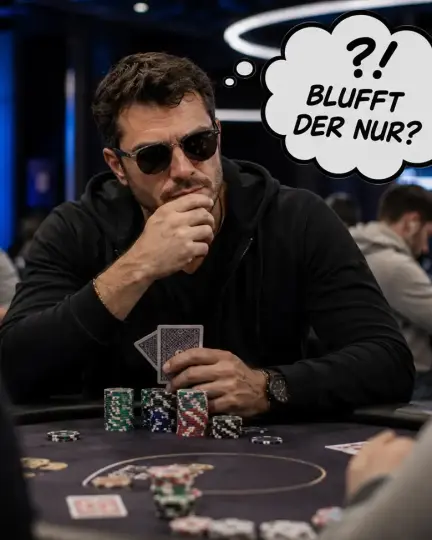
In heads-up, bluff situations can occur more frequently because only a single opponent needs to be convinced. At the same time, this does not mean that every aggressive action is automatically a bluff. Many bets arise from positional advantages, pressure situations or the attempt to take the initiative. Whether a move is actually intended as a bluff always depends on the situation, the board and the course of play.