How does badminton work?
Speed, serves, points, and sports betting. How does badminton work? Learn all about the rules, scoring, and the new 15-point system starting in 2027.
approx. 5 min.
How does badminton work?

In short: with extreme speed, precision, and some pretty amazing physics. Immediately after being struck, a badminton shuttlecock reaches speeds that no other sports equipment can match; the officially recorded Guinness World Record is 565 km/h. At the same time, its unique shape causes it to slow down sharply again as soon as it enters the air.
It’s precisely this contrast that defines the sport: one moment a hard-hitting smash, the next a delicate drop shot just behind the net. Add to that quick changes of direction, deceptions, and a court where just a few centimeters can mean the difference between a point and a fault. But how exactly does badminton work? We’ll explain the rules, the scoring system, and the major change coming in 2027.
Badminton Rules: Objective, Court, and the Fast-Paced Shuttlecock
The basic principle sounds simple: The shuttlecock (or simply “shuttle”) must be hit over the net in such a way that the opposing team cannot return it in accordance with the rules. Unlike in tennis, it must not bounce. If it touches the ground, the rally ends immediately.
Matches are played as singles, with one player per side, or as doubles, with two players per side. There are five events in the competition: men’s and women’s singles, men’s and women’s doubles, and mixed doubles.
The entire court is 13.40 meters long and 6.10 meters wide. In singles play, the court is narrower along the inner sidelines. The net is suspended 1.55 meters high at the posts and slightly lower in the center, at 1.524 meters. The lines are part of the court: if the shuttlecock lands on the line, it is in.
And why does this little shuttlecock, of all things, fly so unusually? A competition shuttlecock weighs just 4.74 to 5.50 grams and has 16 feathers. Thanks to its design, it stabilizes itself after every hit and always flies with the cork leading the way. At the same time, the feathers create so much air resistance that half of its speed is lost after just a few meters. That’s why a relatively short court is sufficient, and why even a record-breaking smash can still be returned.
A Quick Guide to Badminton Rules
- A match is played in a best-of-three format: winning two sets is sufficient.
- Each rally counts as one point, regardless of who has the serve.
- The shuttlecock must not touch the floor during a rally.
- If it lands on a boundary line, it counts as “in.”
- The serve is always hit diagonally into the opposite service box
- If the player’s score is even, the serve is made from the right; if odd, from the left
- At the moment of contact, the entire shuttlecock must be below 1.15 meters
- The shuttlecock must not be artificially spun during the serve; the spin serve is prohibited
- The net and net posts must not be touched during a rally, neither with the racket nor with the body or clothing
- Hitting the shuttlecock twice or “carrying” it is considered a fault
- A tie is not possible
Scoring in Badminton: New Point Rule—From 21 to 15
The biggest change in more than two decades is on the horizon. Until early January 2027, the familiar international system with two winning sets to 21 points will remain in effect. At 20–20, one side needs a two-point lead; at 29–29, the next point decides the set.
Starting January 4, 2027, the World Badminton Federation (BWF) will introduce the new 3×15 system internationally. Matches will remain “best of three,” and winning two sets will still be sufficient for victory. In the future, a set will end at 15 points, the tiebreaker will begin at 14–14, and the set will be decided by the 21st point at the latest.
| Rule | Through January 3, 2027 | Effective January 4, 2027 |
| Match Format | Best-of-Three | Best-of-Three |
| Set win | 21 points | 15 points |
| Extension starting on | 20:20 | 14:14 |
| Maximum score | 30 point | 21 points |
| Pause in a sentence | at 11 point | at 8 points |
| Change of sides in the 3rd set | at 11 point | at 8 points |
Important: “3×15” does not mean three winning sets. A maximum of three sets are played; winning two sets is still sufficient.
Germany is following suit. The German Badminton Association will make the new scoring system mandatory for its individual tournaments for U19 and O19 players starting January 4, 2027. The Bundesliga remains an exception: It will continue to use its own 5×11 system.
How Shorter Rallies Change Tactics in Badminton
Nothing changes in terms of the court, strokes, or serving rules. Mentally, however, a lot changes. An early deficit carries much more weight in a set played to 15: If you’re down 3–8, you simply have fewer rallies left. As a result, the pressure phase also shifts earlier. Until now, things usually got tight starting at 16 or 17 points; in the future, a 10–10 tie will already be a decisive moment. Offensive players are likely to benefit from this, while the long, grueling set loses its value as a weapon.
Good to Know: Why 2027 Counts Toward Your Bet, Too
With shorter sets, every single point takes on greater significance. At the same time, many of the existing benchmarks for point totals, set lengths, and match outcomes are still based on the 21-point system. For badminton bets on points or set outcomes, this means that starting in 2027, past statistics will no longer be directly applicable.
How does a rally work in badminton?
How the Serve Works in Badminton
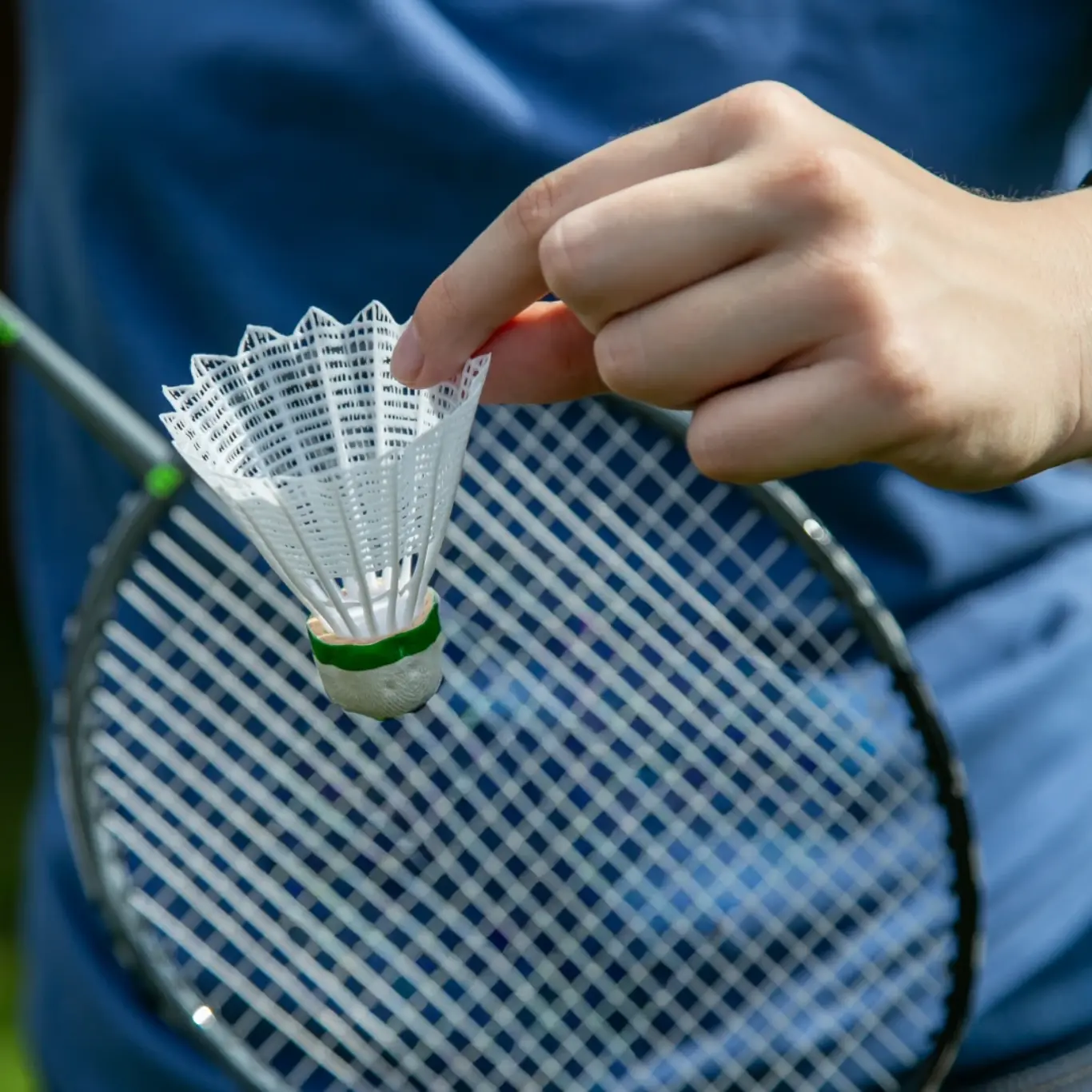
The serve is hit from below and diagonally into the opposite service box. Both feet must remain in contact with the ground, and the shuttlecock may be no more than 1.15 meters above the ground at the moment of contact.
There are three specific points to note here:
- No second attempt: A serving error immediately awards the point to the opponent
- Net roll counts: If the shuttlecock grazes the net and lands correctly, play continues
- Cork first: The shuttlecock must be struck first at the cork base and released without additional spin
Clear, Drop, Smash, and More: The Types of Shots in a Rally
- Clear: high and long to the baseline
- Drop: just behind the net
- Smash: steep and fast toward the ground
- Drive: flat and fast, especially in doubles
- Lift: high from the front court to the back court
- Net shot: as close as possible to the top of the net
It’s the combination that makes it a tactic: a clear pushes the opponent back, while a drop brings them forward again. By skillfully varying pace, depth, and direction, you open up space for the next attack.
Singles vs. Doubles in Badminton: Rules, Court, and How to Play
In singles, one player covers the entire court alone. Positioning, stamina, and the ability to move the opponent from corner to corner therefore play a major role. The court is narrower on the sides but extends all the way to the back baseline.
In doubles, the full width of the court is used, but the service box ends sooner toward the back. Because there are four players on the court, rallies are often flatter and faster.
| Discipline | Player | Field | A typical game scene |
| Singles | 1 vs.1 | narrower | a lot of running, switching between the front and back of the pack |
| Doubles | 2 vs. 2 | full width | High speed, fast drives, attack, and spin |
| Mixed | 2 vs. 2 | like doubles | Same rules, flexible division of roles |
In doubles, team positioning also comes into play. On the offensive, one player is often positioned at the net while the other applies pressure from the backcourt. On the defensive, both players move side by side to cover the width of the court. This shift can occur multiple times during a single rally, contributing to the fast pace of doubles.
Reading Playing Styles: What Matters in a Match and in Badminton Betting
So when you're watching a match, there's more to pay attention to than just the score:
- Attack: Who reaches the shuttlecock early and can frequently apply pressure from above?
- Net play: Who controls the short shots and forces high returns?
- Rallies: Who handles long rallies better?
- Footwork: Who stays stable even after quick changes of direction?
- Versatility: Who skillfully alternates between smashes, drops, and clears?
- Stamina: Who maintains speed and precision even over multiple sets?
Factors like these can also help you better assess a match before placing a badminton bet. An offensive player often tries to end rallies early, while an opponent with strong footwork can force longer rallies. The scores in each set also often reveal more than just the final result.
In many international matches, the favorite is clearly identified. Nevertheless, it’s worth taking a look at form, playing style, and how sets have unfolded, as these factors can make a match closer than the initial odds suggest—and this is reflected in the odds. At MERKUR BETS, depending on the offer, odds boosts or a cashout during the match may also come into play.
The Most Important Tournaments for Your Badminton Bets
Badminton is played at the top international level practically all year round. Here are some competitions you should know about:
- Olympic Games: Medals in all five disciplines; has been a full part of the Olympic program since 1996.
- BWF World Championships: The individual world championships, featuring titles in the five classic disciplines.
- BWF World Tour: An international tournament series spanning the entire season, culminating in the World Tour Finals.
- All England Open: One of the most historic tournaments of all.
- Thomas Cup and Uber Cup: The world championships for men’s and women’s national teams.
- Sudirman Cup: The mixed-team world championship, in which results from multiple disciplines contribute to a country’s overall score.
Anyone looking to bet on badminton will find plenty of head-to-head matchups between the world’s top players at these tournaments in particular—and thus plenty of material for comparing form, playing styles, and recent results.
A small shuttle with quite a bit of action behind it
Now you know how badminton works, when a point is scored, and why a seemingly sure rally can turn around in a matter of seconds. And with the switch to 15 points, the sport will take on a whole new rhythm starting in 2027. At MERKUR BETS, you’ll find sports betting on the biggest events of the year with attractive odds and a wide selection of bet types.
FAQ: How does badminton work?
In badminton, two opponents or two doubles teams hit a shuttlecock back and forth over a net. The goal is to place the shuttlecock in the opponent’s court so that it touches the ground there or cannot be returned according to the rules. Each rally won earns a point, regardless of who served.
Currently, matches are played internationally to two winning sets of 21 points. At 20–20, one team needs a two-point lead; the set is decided at 30 at the latest. Starting January 4, 2027, the international scoring system will change to sets played to 15 points. At 14–14, the set goes into overtime, up to a maximum of 21 points. Two set wins are still required to win the match.
In singles, play takes place on a court that is narrower at the sides, while in doubles, the full width of the court is used. In a doubles serve, however, the court is shorter at the back. The style of play also changes: In singles, footwork and positioning are more important, while in doubles, fast drives, smashes, and position changes often dominate.
That depends on the specific provider, the competition, and the match. Typical betting markets may include match winner, individual set winners, the exact set score, point handicaps, or over/under bets on the number of points scored. Before placing a bet, you should therefore always check which markets and rules apply to that specific match.
In addition to world rankings and current form, head-to-head matchups, playing style, and previous set results can provide useful insights for badminton betting. Some players look to attack early on, while others excel in long rallies. Starting in 2027, the new scoring system should also be taken into account, as statistics from sets played to 21 are not directly comparable to those from sets played to 15.
Playing shuttlecock in the garden is a recreational game without a net, court, or scoring system. The goal is often to keep the shuttlecock in the air for as long as possible. Badminton is an Olympic competitive sport with a set of rules and a scoring system. It is played almost exclusively indoors because even a light breeze can make the shuttlecock’s flight path unpredictable.