How does soccer work?
How exactly does soccer work? An overview of all the rules, game formats, and types of bets. Start placing your soccer bets now at MERKUR BETS.
approx. 5 min.
How does soccer work?

Soccer is the most popular sport in the world and, in Germany, an integral part of many people’s daily lives. Two teams compete against each other, trying to get the ball into the opponent’s goal. For spectators and sports betting fans, the game becomes even more exciting thanks to the tactics, passion, and the constant possibility of a goal. But how exactly does soccer work?
How Soccer Works: The Flow of the Game, the Goal, and the Concept of the Game
The basic concept of soccer is easy to explain: Two teams, each with eleven players, compete to get the ball into the opponent’s goal. The team that has scored more goals at the end of regulation time wins. The game lasts 90 minutes, divided into two halves of 45 minutes each. In addition, there is stoppage time at the end of each half, which the referee determines based on any interruptions.
Field players may use almost any part of their body to play the ball, except for their hands and arms. The only exception is the goalkeeper, who may also use his hands within his own penalty area. Unlike many other sports, a tie is also possible in soccer.
An Overview of the Most Important Soccer Rules
- Two teams, each with eleven players, including one goalkeeper
- Game time: two 45-minute halves with a 15-minute halftime break, plus stoppage time
- The game begins with a kickoff from the center circle. A new kickoff is also taken after every goal and at the start of the second half.
- A goal is scored when the ball completely crosses the goal line between the goalposts and under the crossbar.
- The ball may not be played with the hand or arm; only the goalkeeper is allowed to handle the ball within his own penalty area.
- If the ball goes out of bounds, play resumes with a throw-in, goal kick, or corner kick
- Fouls are penalized with a free kick or, within the penalty area, with a penalty kick.
- A yellow card is a first warning; two yellow cards or one red card result in ejection from the game
- As a rule, five substitutions are allowed per game, spread across three substitution windows.
- If the score is tied, the game ends in a draw; in knockout rounds, extra time and a penalty shootout follow
How Do You Play Soccer Properly? Goals and Positions
The basic principle sounds simple: control possession, create space, and get shots on goal. In practice, soccer thrives on what’s known as the transition game. When a team wins the ball, it switches from defending to attacking. It’s precisely in these moments that most scoring opportunities arise.
For this to work, every position on the court has a clear role:
- Goalkeeper: Prevents goals and is the only player allowed to handle the ball with his hands in his own penalty area
- Center backs: Secure the center of the field in front of their own goal and clear dangerous balls
- Outside defenders: Defend the wings and join the attack when the team is on the offensive
- Defensive midfielder: Acts as a link between the defense and the attack, disrupts the opponent's attacks early on
- Attacking Midfielder: Creates scoring opportunities and brings creativity to the final third
- Wingers: Fast players on the flanks who deliver crosses and create pace
- Forward: The forwardmost position on the field, with one clear primary responsibility: scoring goals
How these positions are specifically filled depends on the team's chosen playing system.
Soccer Rules in Detail: Fouls, Cards, and Set Plays
Not every action on the field is allowed. If rules are broken, the referee steps in and stops the game. You should be familiar with these situations:
- Foul: Illegal physical contact with an opponent, such as kicking, shoving, or holding. The result is a free kick for the opposing team.
- Free kick: If a shot on goal is permitted, the kick is taken directly. In the case of an indirect free kick, the ball must first touch a second player.
- Penalty kick: If a foul occurs in a team's own penalty area, a penalty kick is awarded from a distance of 11 meters directly in front of the goal.
- Yellow card: A warning for the player. Two yellow cards in a single game result in a yellow-red card and, consequently, a sending-off.
- Red Card: Immediate ejection from the game for serious fouls. The team then continues to play with one fewer player.
- Substitutions: Each team may substitute up to five players per game. Substitutions may only be made during three breaks; halftime counts as a separate break.
- Throw-in: If the ball goes out of bounds on the side, it is thrown back in with both hands above the head.
- Corner kick and goal kick: If the ball crosses the goal line, the last touch on the ball determines the outcome. If it was the defending team, a corner kick is awarded; otherwise, a goal kick.
Especially in close games, moments like these often determine the outcome.
Offside, Explained Simply
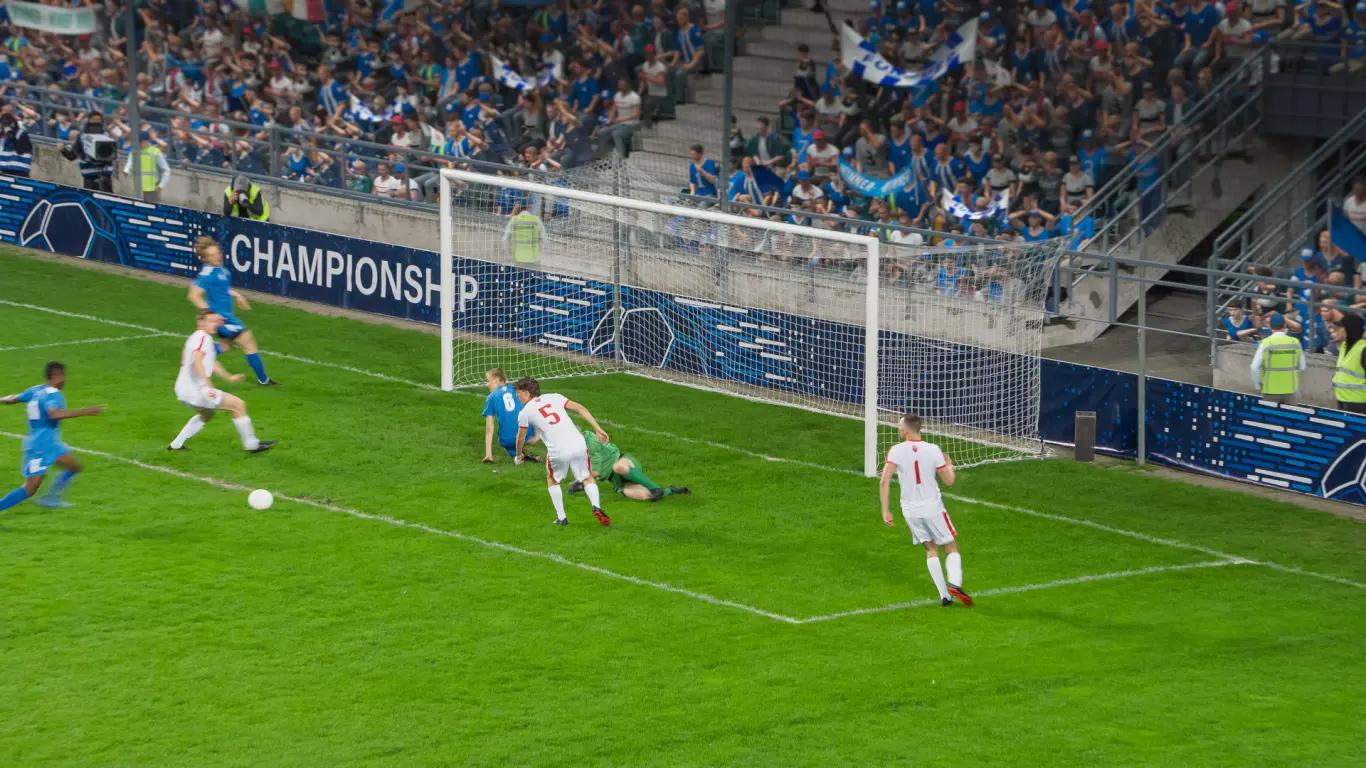
Hardly any other rule sparks as much debate as the offside rule. Yet the principle is straightforward: A player is offside if, at the moment a teammate passes the ball, he is closer to the opponent’s goal than the ball and, at the same time, closer than the last defender (excluding the goalkeeper). The decisive factor is always the moment the pass is made, not the moment the ball is received.
Important to know: Being in an offside position alone is not a foul. The referee will not blow the whistle until the player actually interferes with play.
Without this rule, forwards could constantly wait for long passes right in front of the opponent’s goal. Exceptions are made for throw-ins, corner kicks, and goal kicks. In particularly close calls, video review now assists the referees.
Soccer Tactics: From Defensive and Cautious to Offensive Fireworks
Each team positions its ten field players according to a set system. The combination of numbers indicates how many players are in the defense, midfield, and offense. This often reveals, even before kickoff, whether a team is playing it safe or going on the offensive.
| Playing System | Explanation |
| 4-2-3-1 | A modern system with two defensive midfielders and a single striker up front. |
| 4-4-2 | The classic formation with four defenders, four midfielders, and two forwards. Well-balanced, easy to implement, and the standard system in European soccer for decades. |
| 4-3-3 | Offensively oriented with three attackers. Provides width on the field and keeps the opposing defense under constant pressure. |
| 3-5-2 | Three center backs, but a strong midfield. Focuses on control in the center and flexible wings. |
| 5-3-2 | A defensive formation with five defenders. Often chosen by underdogs who want to stay compact against strong opponents. |

Soccer Sports Betting: Here Are the Types of Bets We Offer
At MERKUR BETS, you'll find a wide range of soccer sports betting options that go far beyond the classic moneyline bet:
- Result: Home win, tie, or away win. The classic soccer bet and the easiest way to get started
- Over/Under: Will there be more or fewer goals scored in the game than a specified total?
- Goal bets: bets on the number and distribution of goals, such as whether both teams will score
- Handicap betting: The favorite starts with a virtual deficit. This results in more balanced odds in matches where there is a clear favorite.
- Halftime Bets: Betting on the score or the course of the game after 45 minutes
- Player Bets: Bets on individual players on the home or away team, such as goal scorers
- Special Bets: Additional Markets Related to Specific Game Events
However, which specific markets are available also depends on the individual game and competition.
Soccer Highlights: A Guide for Sports Betting Fans
Anyone who wants to bet on soccer should be familiar with the competitions that are regularly featured in the betting lineup:
- Bundesliga and 2. Bundesliga: The top two German leagues take center stage every weekend. Thanks to the high level of media attention, the betting markets here are particularly extensive, ranging from simple moneyline bets to player-specific wagers.
- Champions League: Europe's premier club competition features top-tier matches at the highest level throughout the week. Especially during the knockout stage, long-term bets on the tournament winner and handicap bets on clear favorites are particularly interesting.
- Top international leagues: The Premier League, LaLiga, Serie A, and Ligue 1 are a staple of the betting lineup. These leagues feature matches almost every day, providing a constant stream of new betting opportunities.
- DFB Cup: The knockout format regularly produces upsets when lower-division teams face Bundesliga clubs. Underdog odds are particularly attractive here.
- National Teams: The European Championship, the World Cup, and their respective qualifying matches offer long-term betting opportunities that span several weeks.
These competitions form the basis for soccer sports betting at MERKUR BETS. By looking at the standings and the teams' rosters, you can assess the outcome of a match much more accurately.
An Overview of Your Soccer Sports Betting
Do you understand the rules, know how the teams are ranked, and have a handle on the most important bet types? At MERKUR BETS, new matches from the Bundesliga, the Champions League, and the top international leagues await you every day. Pick your game and place your bet!
FAQ on How Soccer Works
Two teams, each with eleven players, compete against each other and try to score goals in the opponent's net. The game lasts 90 minutes, divided into two halves. The ball may be played with any part of the body except the hands and arms. Only the goalkeeper is allowed to handle the ball with his hands within his own penalty area. The team that has scored more goals at the end of regulation time wins.
A regular soccer game lasts 90 minutes, divided into two 45-minute halves with a 15-minute halftime break. In addition, there is extra time, which the referee determines based on game stoppages. In knockout games, if the score is tied, the game goes into extra time consisting of two 15-minute periods, followed by a penalty shootout.
A player is offside if, at the moment a teammate passes the ball, the player is closer to the opponent’s goal than the ball and, at the same time, closer than the last defender. The goalkeeper does not count toward this determination. The decisive factor is always the moment the pass is made. There is no offside rule for throw-ins, corner kicks, and goal kicks.
A yellow card is a warning for a foul or unsportsmanlike conduct. If a player receives two yellow cards in a single game, they are shown a yellow-red card and are sent off. A red card is shown immediately for serious offenses and results in immediate ejection from the game. The team then continues to play with one fewer player.
When betting on soccer, you place bets on the outcome or specific events of a game. In addition to the classic win bet—home win, draw, or away win—MERKUR BETS offers a variety of other options, including over/under bets, goal bets, handicap bets, halftime bets, as well as player and special bets.