How Does Table Tennis Work?
Rules, Serve, and Scoring. How does table tennis work, and what kinds of competitions are there? Learn more and bet on table tennis at MERKUR BETS.
approx. 5 min.
How Does Table Tennis Work?

Table tennis is one of the fastest racket sports in the world and is played by millions of people, from recreational settings to the Olympic stage. In singles, two players face each other across a table and engage in rallies in which the ball reaches speeds of 50 to 70 kilometers per hour. The pace is particularly appealing to spectators and sports betting fans, as a set can be decided in just a few minutes. But how exactly does table tennis work?
Understanding Table Tennis: Structure, Objective, and Rules of the Game
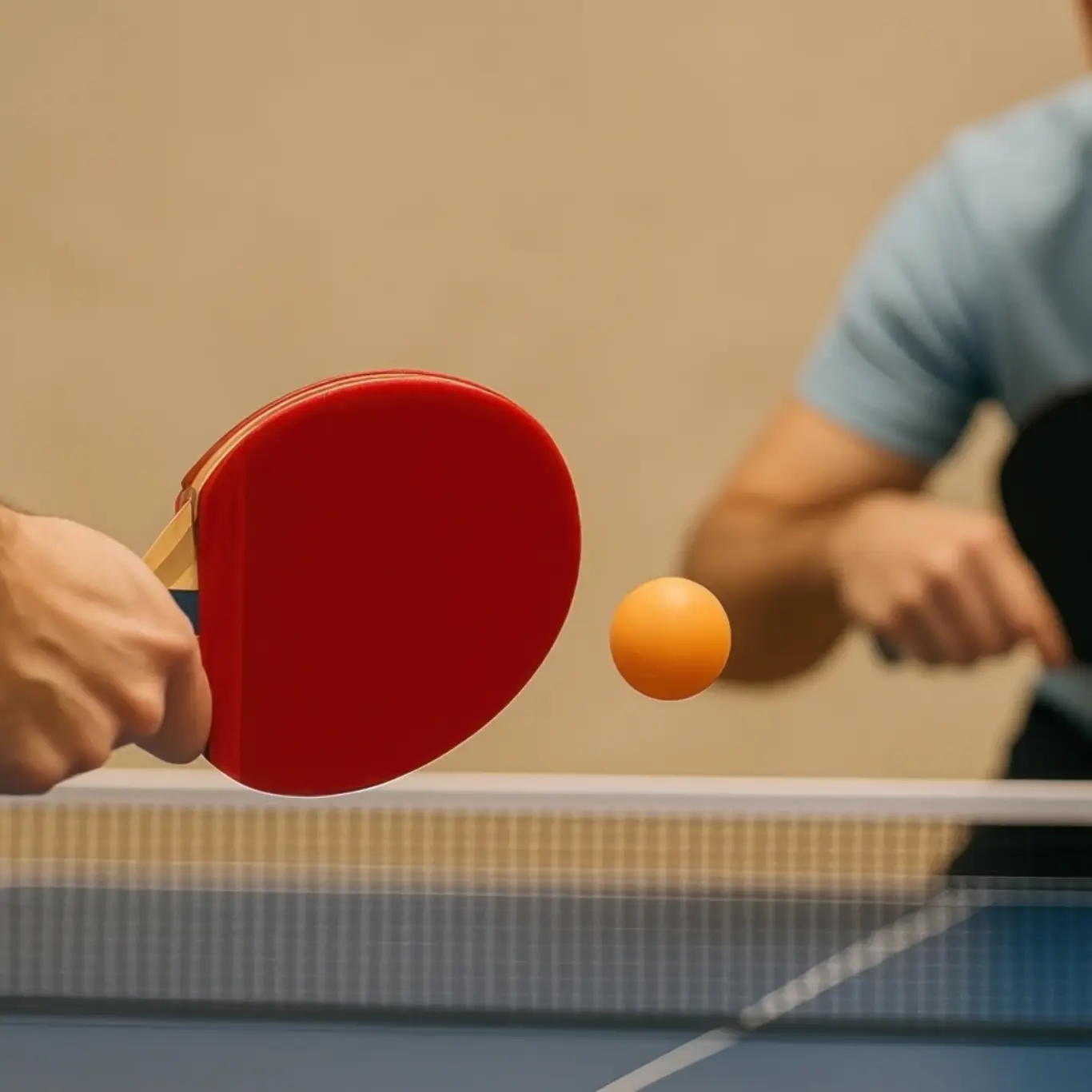
Two players stand across from each other at a table tennis table, separated by a net in the middle. The goal is to hit the ball over the net in such a way that the opponent cannot return it according to the rules. The ball must always bounce exactly once on the opponent’s half of the table before the opponent hits it back.
A match ends only when one of the two players has won the required number of sets. In addition to the classic singles match, there is also doubles, in which two players form a team and slightly different rules apply. Incidentally, a tie is not possible in table tennis; every match ends with a clear winner.
The Most Important Table Tennis Rules at a Glance
- The game is played as singles (one player per side) or doubles (two players per side).
- When returning the ball, it must bounce exactly once on the opponent’s half of the table.
- A point is scored if the opponent hits the ball into the net, off the table, or fails to return it at all.
- A set is played to 11 points, but is won only by a margin of two points.
- When serving, the ball must first touch your own half of the table, then the opponent’s half.
- The serve alternates after every two points; after 10–10, it alternates after every single point.
- After each set, the players switch sides, with a one-minute break in between. In the deciding set, the sides are switched additionally as soon as a player reaches five points.
- A player wins a match by being the first to win three sets (best-of-5) or four sets (best-of-7)
Scoring in Table Tennis: How Points and Sets Are Determined
In table tennis, points are scored on every single rally, regardless of who is serving. Whoever hits the ball into the net, misses the table, or fails to return the ball loses the point.
A set ends at 11 points, but only if a player has a lead of at least two points. If the score is 10–10, the set goes into overtime and continues until one side has the required lead. Scores like 12–10 or 15–13 are therefore not uncommon. The number of sets required to win a match depends on the competition.
| Competition | Set Mode in Singles |
| German Bundesliga (TTBL) | Best-of-5 (3 winning sets) |
| WTT Tournaments | Mostly best-of-5 |
| World Championship | Best-of-7 (4 winning sets) |
| Olympic Games | Best-of-7 (4 winning sets) |
How do you play table tennis? Serve, return, and rally

Here are the rules you should know:
- Serve: The ball is tossed vertically from an open palm at least 16 centimeters high and struck from behind the end line.
- Sequence: The ball must first touch your own half of the table, then the opponent’s half.
- No second chance: Unlike in tennis, there is no second serve if you make a serving error; the point goes directly to your opponent.
- Net serve: If the ball touches the net during the serve and lands correctly on the opponent’s half of the table, the serve is repeated.
- Blocked serve: The ball must remain visible to your opponent at all times. If you block the ball with your body or arm, you lose the point.
- Return: The ball must bounce exactly once on your own side before it is returned.
These errors result in an immediate loss of the point:
- Catching the ball in the air before it has bounced on your own side
- Touching the table surface with your free hand while the ball is in play
- Touching the net or net support, whether with the racket, hand, or clothing
- Moving the table surface
- Touching the ball twice in a row
- One special case regularly sparks debate: If the ball hits the top edge of the table, it counts as normal. If it hits the side surface, the point is lost.
Doubles in Table Tennis: What's Different?
In doubles, two players form a team, and there are a few additional rules that apply. The serve must be made diagonally—that is, from the player’s own right half of the table to the opponent’s right half. If the ball lands in the wrong half, the opposing team is awarded a point immediately.
The second rule concerns the order of play: the two partners must strictly alternate when hitting the ball. Hitting the ball twice in a row is not allowed, even if your partner is in a better position to return it. That is precisely why coordinating movement in doubles is at least as important as racket technique.
Stroke Techniques and Playing Styles in Table Tennis
In table tennis, it’s not just speed that matters—it’s technique above all else. A technically well-executed shot can put the opponent in trouble even if the ball crosses the net slowly.
These are the most common shots:
- Topspin: The most important offensive shot. The ball is given forward spin, flies over the net in an arc, and then bounces forward quickly and flat.
- Push: A defensive shot with backspin that keeps the ball low over the net and makes it difficult for the opponent to attack.
- Block: The racket is held steady and returns the opponent’s shot at the same speed.
- Smash: A direct attacking shot on high balls, usually hit with full force and often resulting in a point.
- Counter: A quick return played right at the table to prevent the opponent from having time to set up.
The Most Important Table Tennis Tournaments and Leagues
Table tennis is played year-round, both nationally and internationally. Here are some competitions you should know about:
TTBL: The German Table Tennis Bundesliga is Germany’s top division and has been in existence since the 1966–67 season. Twelve teams compete, and the champion is determined through playoffs. Borussia Düsseldorf is the all-time record holder by a wide margin.
WTT Series: The international tournament series organized by the World Table Tennis Federation, featuring formats such as Grand Smash, Champions, and Contender. This is where the world’s absolute elite face off, with matches played throughout the year.
World Championships: Alternating annually between the Singles World Championships and the Team World Championships, this event is considered one of the most prestigious titles in table tennis.
European Championships: The continental title competitions featuring singles, doubles, and team events.
Olympic Games: Every four years, five disciplines are on the program, including mixed doubles, which has become a highlight in its own right since 2020.
International Leagues: The Chinese Super League is considered the strongest league in the world, and there are also numerous European competitions with matches taking place almost daily.
One thing stands out in almost all major tournaments: China has dominated the sport for years. Several Chinese players consistently rank among the top 20 in the world rankings. For table tennis betting, this means that the favorites are often clear, and it can be particularly worthwhile to keep an eye on the underdogs.
Ready to place your table tennis bet?
Now you know how table tennis works and what matters when it comes to scoring, serves, and playing styles. At MERKUR BETS, you’ll find matches from international tournaments and leagues. Pick your match and place your bet!
FAQ on How Table Tennis Works
Two players stand across from each other at a table and take turns hitting the ball over the net. The ball must bounce exactly once on the opponent’s side of the table. The game is not played by time, but by sets. The player who wins the required number of sets wins the match. There are no ties.
A set goes to 11 points, but it’s not won until a team has a lead of at least two points. If the score is 10–10, the set goes into overtime until one side has the necessary lead. Scores like 12–10 or 14–12 are therefore not uncommon. Incidentally, until 2001, sets were played to 21 points.
During regular play, the serve alternates after every two points, regardless of who scored them. This changes once the score reaches 10–10: In overtime, the serve alternates after every single point. A coin toss determines who serves first in the first set.
The ball must be tossed vertically from an open palm to a height of at least 16 centimeters and must remain visible to the opponent at all times. A serve that is blocked by the body or arm is prohibited and results in an immediate point for the opponent. There is also no second attempt: a serving error immediately results in a point for the opponent.
In doubles, two players form a team. The serve must be made diagonally—that is, from the player’s own right side of the table to the opponent’s right side. In addition, the partners must strictly take turns hitting the ball. Hitting the ball twice in a row is not allowed and results in a point loss.